

What Makes a Manager "Emerging"?
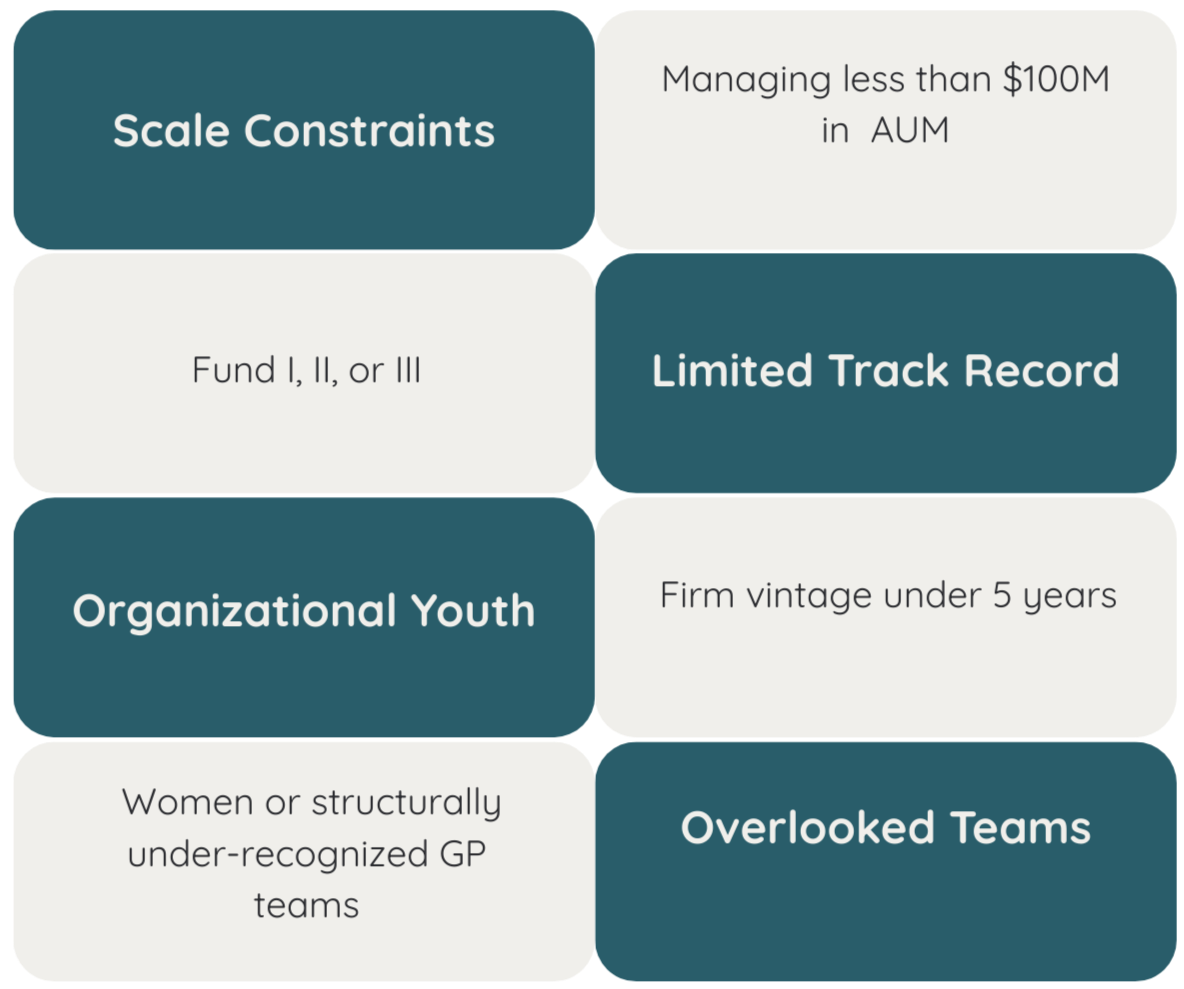
Emerging managers are defined by systematic exclusion from institutional search processes, not by demographics or identity.
A fund qualifies as "emerging" if it meets any one of these criteria:
Emerging Managers Consistently Outperform
Our analysis of 2,471 U.S. venture capital funds (2000-2024) reveals a persistent advantage.

Impact:
On a $100M allocation, this translates to $72M in foregone returns when institutions underweight emerging managers.
Why This Matters
For Institutional Allocators
Current screening processes (AUM thresholds, fund sequence requirements, brand preferences) systematically exclude the managers most likely to outperform. The cost is measurable and compounds over decades.
For Emerging Managers
This research provides the empirical evidence your LPs need to justify early commitments. Performance differences aren't speculative. They're documented across 25 years and 2,471 funds.
For The Ecosystem
Underfunding of emerging managers isn't a capability problem. It's a market inefficiency. Institutions that recognize this dynamic gain first-mover advantage in accessing alpha-generating talent.
Emerging Manager Program Diagnostic
Our Institutional Diagnostic Assessment translates the findings of this research into a practical self-evaluation for institutional allocators running or considering an Emerging Manager program. It assesses whether program design and execution are structurally positioned to capture venture alpha.
Venture Capital Platform Diagnostic
Our Venture Capital Platform Diagnostic Assessment was designed with the purpose of helping emerging venture capital managers evaluate whether their fund platform is structurally configured for institutional capital or constrained by gaps in strategy, infrastructure, governance, or fundraising readiness.
What Actually Drives Outperformance
Core Findings:
Emerging managers build portfolios differently: smaller checks ($17M vs. $60M), broader portfolios (28 vs. 37 companies), and earlier stage. These aren't deficiencies. They're strategic adaptations aligned with constraints.
Configuration, Not Identity:
For emerging managers, broader portfolios significantly improve returns. For established funds, breadth adds little. Power-law dynamics reward different strategies under different resource constraints.
Portfolio Breadth Matters:
Larger checks benefit established funds but penalize emerging managers. Funds maintaining $5-15M average checks outperform those stretching to $20M+.
Check Size Discipline:
Enterprise risk is driven by operational fundamentals (governance, financial health, team dynamics), not fund size. Many emerging managers present lower operational risk than larger platforms.
Size ≠ Safety:
Funds with women GPs deliver comparable or higher returns (+1.6% IRR) despite documented fundraising barriers. Underrepresentation reflects access constraints, not capability gaps.
Women GPs Perform Despite Barriers:
First movers who build disciplined emerging manager programs gain access to top performers before broader institutional recognition. And the relationships compound across investment cycles.
The Opportunity Is Real:

About Colibrí Institute
Colibrí Institute strengthens venture capital ecosystems by producing open research, informing the capital and policy systems that determine who builds, and who benefits from, technology, and coordinating stakeholders to turn evidence into durable action.
The Authors